
My Pirate Days
Adventures on the high seas of the 1990s Internet

Rob grabbed a clunky, suction-cup type handle tool from his desk and in one smooth motion, yanked a panel out of the raised floor in the back corner of the telecom room. Dust particles briefly surged up and were carried away by the air handling system. I nestled the pizza-box sized computer chassis beneath the floor then plugged it in to a carefully concealed extension cord and activated the power switch on the back. In about two minutes, we had run a carefully concealed cat5 ethernet wire to our new pirate machine and had the other end attached to a free port on the campus’ main computer switch. The box was ready. and the floor buttoned back up. Rob had carefully woven the ethernet wire through the back loom of the switch hardware and zip-tied it to the back vertical leg of the rack. To any casual observer, nothing was amiss, the yellow wire running down through the floor was barely noticeable. Other than Rob, almost nobody ever went in the switch room, anyways. He could just as easily have set the box on his desk, but hiding it just felt more appropriate given its purpose. Thus began an approximately two-year experiment running a pirate FTP service on the Internet.
Rob Gillis
Rob was a farm kid turned techie by way of the school’s Geography Department. He had worked on some GIS code for his senior thesis, then wormed his way into a quasi-full-time job on campus supporting the computer labs. He got the job mainly because his buddy John ran the place. Back then, you didn’t need a whole lot in the way of certifications. It was more just demonstrating obsession with computers and networks that mattered. Rob wasn’t a bad guy at all. He was happy-go-lucky and loyal, but just a total redneck and slob. He drank a lot of chocolate milk. He had low expectations. Not good-looking or fit by any stretch, but kind of “farm strong” and stubborn.
I met this character because one of my compsci profs told me that I could get a hold of a Borland C compiler for my personal PC if I went to the computer center and asked the folks there nicely. They had a site license for the software, and well, I was technically “on site” even if the computer wasn’t exactly owned by the college. The first person I met at the Academic Computing Support Center (ACS) was John Boberg, the brains of the organization. There was a snazzy Macintosh computer on his desk and spent his time fiddling with configurations, buying hardware and software, and managing the roll-outs. He was the campus IT fire-fighter doing about five things seemingly at once, always constantly interrupted by phone calls. His seating area smelled like stale coffee, the trash can was brimming with takeout food containers, and the off-white plastic Mac keyboard and desk phone had that layer of compacted black grime on the high-touch sections. There were stacks of magazines and books everywhere—PC Week and Mac Week trade rags were prolific (yes, they were weekly magazines because the biz was so fast-moving back then). There were also piles of catalogs, generic-looking IBM manuals, boxed software, and various computer components, keyboards, mice, and jumbled up wires jammed into various cardboard boxes. This was one of the the nerve centers of the campus where the real work got done keeping everything running.
While friendly, John had no time for me, and so he introduced me to Rob and went back to his busy day.
My recollection is that Rob had only recently gotten hired there part-time when I first met him. He blew his first paycheck on a Mac laptop because the college hadn’t even bothered to furnish him with a work computer like John’s. I don’t think the college ever treated Rob very well, he was basically a gopher. His main work gear was a metal cart that he used to lug computers and CRT monitors in and out of various labs around the campus. When John got a call that something broke, Rob was sent out to investigate, then invariably haul back some busted piece of tech on that cart. Hopefully, some replacement was available, but not always. Rob spent a lot of time keeping projectors and audio devices in classrooms up and running. He was a jack-of-all-trades, albeit a blunt instrument.
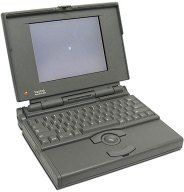
I knew right away that Rob and I were going to be friends. He was witty and results oriented. I was hungry for knowledge and resources. I just wanted to be part of the exciting world that was Information Technology circa 1992.
Linux
Our first real bonding experience together was when we stayed up all night installing “Slackware” on a 386sx 20MHz computer that Rob had liberated from a heap at the local dump when he was throwing away his sofa. Rob would do odd-jobs for cash and he had a Ford Ranger pickup, so he would often move furniture for people or dispose of bulky items. Rob’s ape-like, stocky frame and farm strength allowed him to single-handedly move heavy, oblong items like washing machines without any assistance. He had gotten hired to take a professor’s old couch to the dump, but that guy’s couch was nicer than Rob’s own couch, so Rob hauled it back to his apartment and instead took his own couch to the dump. Progress achieved! Anyways, in the process of doing the switcheroo, he had come across a couple of busted up PCs slightly covered in snow and snagged those back to his lair. With a bit of work, two broken computers became one working unit by way of de-soldering some dead capacitors and re-soldering in a couple of new capacitors onto one of the motherboards. It was the 18th century farmer mentality applied to a late 20th century situation.
It was my idea to goof around with this new operating system called Linux. I’m not exactly sure what year that was, somewhere between 1993 and 1994, probably. We stayed up all night in Rob’s apartment making install disks and trying to get X-Windows working with the crappy video card in that junk PC. We only ever got it to boot to a terminal because hardware compatibility in those early days of Linux was completely hit or miss. Rob also owned a fairly nice 486 tower PC that featured a higher-end video card and SCSI hard drives. We eventually gave up on the old 386sx and just set up his 486 to dual boot Linux and Windows. It took hours of messing around to make it all go using the rudimentary hard disk partitioning tools available at the time. Any wrong move could wreck everything and force you to have to start over from scratch.
The UNIX Cult
The reason I became so obsessed with Linux was because I wanted to learn to use UNIX. The campus infrastructure as based around VAX/VMS hardware, which was a competing type of product in what was referred to as the “minicomputer” space. The VAX was hardly “mini” in today’s terms, because it still took up a decent chunk of floor space in the campus’ main computing center, but it was far smaller than the mainframe that it has replaced. At various times I was allowed to visit the main computing center (the one that had housed all the student records and really important data like that) and John showed me where the mainframe had been and how much space it had taken up compared to the far more sleek VAX system which was actually two different machines acting on concert, which was VMS’s claim to fame, the ability to cluster the hardware and build out a powerful computing system for the time.
There were no UNIX systems on that campus around that time at all. This was not Berkeley, just a honky-tonk state college in Upstate New York! The first UNIX machine I ever saw was a DEC1 workstation that a computer science professor bought using some grant money. The students all got accounts on that one DEC UNIX box, but it was poorly supported and locked in a room. You could access it via telnet, which I did, and I wrote a few shell scripts and compiled some C programs on it, but it couldn’t really do much else. But it was so cool! UNIX was the cool operating system and if you knew UNIX, you were a rock star.
My First Work Experiences
I got my first job at an ISP when I was just out of college in the summer of 1995. My success in getting hired was largely due to the experience I had built up using Linux. By the time I graduated college, Linux had crystallized into a solid product and was compatible with a lot more PC hardware. I had been able to construct my own “Linux box” complete with a working graphical desktop windowing system. That felt like a fairly major achievement at that time. I had also been in charge of the college’s “Gopher” campus-wide information service (CWIS), which was a precursor to the World-Wide Web, which was the latest thing. Gopher was a text-only hierarchical information base, and was all the rage for about six months until the WWW hit in full force after which Gopher would become a minor footnote in the annals of the Internet. But for a brief moment, I was flying high with Gopher because John had gotten a small grant to build the CWIS and paid me for a whole summer to get it all set up and then go out and solicit various campus offices and departments to begin making their information public there. That was an incredibly cool summer job and I thank John from the bottom of my heart for having had that experience. Oh yeah, and part of that job was helping Rob refresh some computer labs around campus, which also afforded me hands on experience.
Enter SparcBox
I bought a used SparcStation 1 sometime right after I started working. My memory of this time period is hazy because a lot was going on at the time. What I recall is that I bought the bare machine off of someone on Usenet News, like someone from Berkeley or someplace that had a lot of surplus Sun Microsystems hardware. It was probably a west coast analog of Rob—selling the university’s surplus gear out the back door. I think I paid like $100 for it, but who really knows? My Sparc came in a cardboard box with a single, thin piece of foam wrapped around it in what amounted to a really half-assed attempt at protecting it during shipping all the way across the country to New York. The machine was just a motherboard, power supply, the floppy drive, and a couple of disconnected SCSI ribbon cables. It had no RAM nor a hard drive. I would have to somehow acquire those other parts.
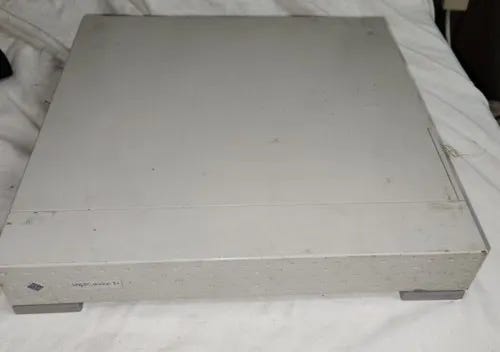
Fortunately, these machines had like 16 slots for RAM. Also fortunately, Rob had just completed a round of memory updates to the computers in some of the campus labs. He was taking them from 4MB of RAM up to 8MB of RAM, effectively doubling their memory capacity, which a sort of poor man’s hot rodding you could do back then to squeeze a little more life out of your PC investment. The Sparc used the same RAM boards, or SIMMs as those PCs, so after Rob updated all those lab machines, he had a desk drawer literally full of now-useless 1MB SIMMs which were headed for the trash. Naturally, Rob was more than happy to make a few disappear for me. We filled every slot on the Sparc’s motherboard—a whopping 16MB of RAM!
The next step was getting a hard drive that worked with the SparcStation. Sun Workstations used SCSI2 as the bus for the hard drives. SCSI was the “Cadillac” spec for interfacing peripherals such has hard disks, floppy drives, and CD-ROM drives back then because it used a 32-bit bus, which could address a much greater range of memory locations versus the usual 16-bit busses common at the time. Macintosh computers used SCSI, but most PCs used the cheaper 16-bit standard know as ISA.3 Most baller PCs back then would be sporting a tower or mini-tower case and have all the drive bays filled up. The ISA bus could handle two hard drives, a CD-ROM, and two floppy drives, if the builder was savvy about setting all the jumpers on the correct address pins to make it all go. Building PCs required a bit of hands-on ability, knowledge, and most of all—patience. PCs that featured SCSI cards were pretty high-end because they could be loaded up with a bunch more peripherals and were meant for building clusters of hard drives in data centers.
For whatever reason, Rob had built himself a PC with a SCSI card in it. Rob’s was pretty much the only PC I ever saw in person that had a full SCSI setup in it. It’s not like it was impossible to get or anything, it was just way more expensive. I think Rob told me he sold a car or something so he could build that PC when he was doing his GIS work or whatever. Rob often told tall tales, so who knows.
My PCs were always just the ho-hum AT types. The biggest hard drive I owned around that time was like 120MB, which was enormous to me. Thus, I had no SCSI parts of any kind sitting around and Rob couldn’t come up with anything, either. More on this dilemma in a moment…
The Sparc had another annoying problem—it would not work with any VGA monitor off a PC, it had it’s own proprietary video interface using a trio of BNC type connectors like it was some kind of high-end stereo equipment or something. I honestly do not remember how I overcame that issue. I may have purchased a VGA adapter, but I probably just used the RS-232 serial port on the Sparc and ran a cross-over wire to my PC running Linux and did terminal emulation. I recall having a Sun keyboard and the cool optical mouse, which someone had given me, so it’s possible I had the full X-Windows GUI going at some stage.
What I fully remember is that the NVRAM battery on the Sparc was dead.
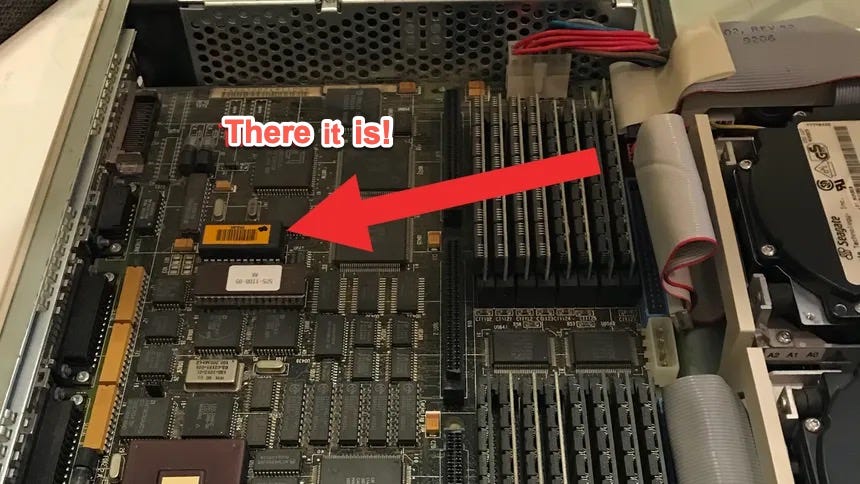
The Sparc would not boot up because of this problem. It took me hours of poring over Sun Workstation related Usenet posts before I figured out the cryptic error messages the machine kept looping onto the screen. The stupidest thing Sun did was put a battery literally inside of the boot ROM chip and then design the thing so that if the battery went bad the whole god damn machine would be useless. All PCs at the time had a battery on the motherboard that was easily replaceable, but not Sun—those crappy bastards had to go and build in obsolescence. These days, the issue is well known and people wishing to run old Sun hardware have some easy work arounds to that problem. I had no idea about any of that because the civilization-changing wonder known as Youtube was still about a decade away. I had very few information resources available besides Usenet News and email, but through those was able to find a place that would sell me a replacement NVRAM and the install media for Solaris! Both items were fairly inexpensive as it turned out.
I got the NVRAM replaced and got the machine to boot from the CD-ROM using a borrowed SCSI CD-ROM drive. I have no recollection where the CD drive came from or were it went. I only remember that it was an external SCSI CD-ROM that had a tray you put the CD in and then fit the whole thing into a slot on the drive itself.
Larceny
The story of the hard drive took a much darker turn. It turns out that SCSI hard drives of any capacity were pretty expensive. Used hard drives were usually “broken hard drives”—it was not a good bet to buy those things used. As fantastic as it was, the technology of spinning specially coated platters at high speeds while tiny read heads floated less than a millimeter above each coated surface was not a formula for longevity. Head “crashes” were very common and rendered drives unusable and the data on them beyond the reach of anyone except highly paid recovery technicians.
What to do?
As it turns out, the ISP4 company I was working for was building out POPs5 to be placed in secure telco facilities all around the country. A POP was basically a set of modems attached to a computer that could handle authentications and other essential functions. That computer was connected to a fat Internet pipe, like a T1 line or better via an ethernet bridge or some such. The computer connected a local LAN via its ethernet network interface and itself acted as a bridge between the dialup modem side and the always-on Internet side. Each of these computers was customized at our office location before being sent out into the field to be installed. In this company’s case, the standard build was an off-brand (non-Sun) Sparc 20 workstation, a newer, faster version of the older Sparc 1 I had bought. Each of these Sparc 20s had four 1GB external SCSI hard drives attached, for a total of 4GB, an unbelievably vast amount of storage for that time period. Each box also included an impressive amount of RAM for the time, like 64MB or something like that. In contrast, my Sparc 1 couldn’t even address that much RAM.
I was not on the team building those machines, but I had access to some of those rooms. These builds were going on fast—machines arrived, were modded on site, then re-packaged and shipped back out. They had pallets of parts and raw materials located in a storage room. The hard drives came packaged in their neat little external enclosures, ready to be daisy-chained together with external cabling. If any item failed in final testing, it was simply set aside and a new unit was attached in its place. Did I mention hard drives at this time were kind of unreliable?
In one of the back rooms there was stack of 20-30 rejected SCSI drives. They were supposed to be shipped back to the manufacturer for a refund, but nobody had time because the whole place was a beehive of activity. The only thing that mattered was building out a national network, the refuse could wait. So, one evening when I was leaving late, I perused the “junk pile” and noted one of the enclosures that had a broken connector. The enclosures had a “SCSI in” and a “SCSI out” pair of ports type of deal because external SCSI hardware was meant to be daisy-chained and I could see that one of them was bent and partially snapped off. I quickly deduced that the drive inside that enclosure was probably fine, just the enclosure box was defective. These particular boxes didn’t use any screws, they just had a couple of tabs to hold the top and bottom sections together. In less than a minute I had that one open using my pocket knife and was able to slide the drive right out of the enclosure. A quick glance around the room later and then the drive was “installed” in my lunch box, the enclosure snapped back together and randomly returned to the middle of one of the stacks.
I can hear what you’re thinking: “Wait, what? You stole a hard drive from your employer?”
“Yes, yes I fucking did.”
Even I was surprised by such brazen behavior! It was definitely a calculated, opportunistic crime. In truth, I had been eyeing that pile for some time, waiting for the exact right moment to strike. Premeditated larceny! Sullen head shake. My probation officer from just a couple years earlier would not have been proud at all! I had clearly not fully rehabilitated from my days as a juvenile delinquent. Looking back, I think a lot of Rob’s behavior back at the campus rubbed off on me—back there, everyone “made do” and repurposed old/unused hardware and equipment because they didn’t have the budget to buy new things. I was now in a different world where time was more important than the budget and here was serviceable equipment just lying around.
I rationalized my behavior knowing that equipment would get returned and the manufacturer would just unceremoniously auction it all in some huge lot of “as is” parts in some giant cardboard box on a pallet. Worse, maybe it would all just immediately end up in some landfill in the Philippines—you know, the ones you saw on “60 Minutes’ with the dirty kids climbing over mountains of discarded American tech? That’s what I imagined when I stole that 1GB drive, that I was liberating it so that it had a future in the sense that it was at least going to get some use before it ended up back in some shit pile somewhere, like those 386 machines Rob got out of the dump. I was being environmentally conscious!
It didn’t occur to me at the time, but it’s possible that other guys building out the machines there were also picking through the discards because it was only a couple of weeks later that the whole stack of reject drives disappeared to a different room that was under lock and key (not returned or anything, mind you) and the rest of the build operation became sequestered behind locked doors. It’s not unreasonable to suspect that another employee with even fewer scruples than myself may have walked out of there with an entire Sparc 20, drives and all. They weren’t exactly paying us a lot, is all I’m saying, and they were easy pickings since this was a time when there were no workplace cameras whatsoever. I swear to you, the reader, that I have no idea what else may have gone down. I didn’t steal anything important or actually needed by that company. I removed what was essentially trash to them and nothing more. It is highly doubtful that anyone noticed that one slightly lighter drive enclosure, so it must have been some larger incident that triggered the crackdown. I was somewhat paranoid and looking over my shoulder there for quite awhile after that, but nothing ever came of it.
SparcBox is Born
With a whopping 1GB of storage in hand, I wasted absolutely no time getting my Frankenstein monster put together and running. Once “SparcBox” was a going concern, the question then became what to do with it? It wasn’t really good for much without the special monitor. I could “telnet” to it on my basic little home network which basically consisted of one PC, a cheap 4-port ethernet hub6 and the SparcBox workstation. I had achieved ownership of a working UNIX box via the gray market, filled it with quasi-stolen RAM, and a fully stolen disk. The only logical next step was to use it for piracy!
Final Thoughts
SparcBox ran, hidden under the floor of a data room, for approximately two years. It was hopelessly obsolete the day I first got it, and then tack a couple more years on there and it was good and done by then. It was host to a wide array of uploaded and downloaded “warez” which is what the hacker kiddie community called stolen copyrighted software. Rob and I only opened it up to a close group of like-minded colleagues and we used it basically the way people use a cloud drive today, just not as seamlessly. We mainly used FTP to move files to and from the box, but also played around with early drive mounting technology called NFS that could function over ethernet, which paved the way for NAS (network attached storage). Back then, it was kind of clunky and unreliable.
As I sit here writing, I can’t help but crack a smile. Those were adventures that young people can’t have anymore. Computer crime was not taken seriously, and I really felt like a spy when I undertook the daring mission of sneaking the SCSI drive right out from under the nose of my employer. That company went belly up, by the way—when the “bigs” like AT&T got into the ISP game it was all over for the little guys leasing T1s and T3s from their competitors. There was no way to profit after that and they laid everyone off and folded up shop. I would wager that all those Sparc 20 machines they built were never even recovered or auctioned off, they probably just got turned off and took up space in those telco facilities until someone eventually came by and threw them out. The ugly legacy of the entire tech industry—equipment is purchased at high cost, used briefly, then discarded. Optimistically, the discarded gear is surplussed and gets a second life somewhere, but more often than not it just ends up in a landfill in the 3rd world where filthy humans scrape out some kind of meager existence living amongst the remnants of a world they have no concept of. It all becomes part of the sad, long-term environmental and societal impact of human progress.
SparcBox met the same fate as everything else—when Rob eventually got promoted from the bottom rung, they no longer had him working out of the machine room. He decided that having SparcBox down there was too risky at that point and we agreed he should remove it. It was sometime around 1998 that it was turned off for the last time. I had already moved to North Carolina and was working a developer at a company there. Rob mailed me the hard drive, but SparcBox itself became just another piece of trash on the mountain of trash equipment the college threw out every year. I never even spun the drive up again after that. It lived in a box of “tech crap” that everyone who works on computers seems to have. My box of power cables, ribbon cables, power supplies, hard drives, SIMMs, and yes, the purloined SCSI drive was recycled sometime around when we moved away from North Carolina. It was all well-loved.
DEC is Digital Equipment Corp, maker of the PDP-11 and VAX systems, and later, DEC UNIX
Small Computer Systems Interface https://en.wikipedia.org/wiki/SCSI
https://en.wikipedia.org/wiki/Industry_Standard_Architecture. I had to look this shit up, it’s been awhile…
Internet Service Provider
Point(s) of Presence
Yes, “hub” not “switch” a technology that would arrive a little later on